The Science and Stories of the Aurora Borealis in Manitoba

Posted: November 02, 2026 | Author: Allison Dalke and Renée Simcoe | Estimated Read Time: 6 minutes

The night sky has fascinated people for millennia, from stories that helped make sense of the world to early explorers using the stars to navigate. No matter where you are, when you look up at the night sky, you can't help but wonder about one of nature's most stirring phenomena—the aurora borealis.
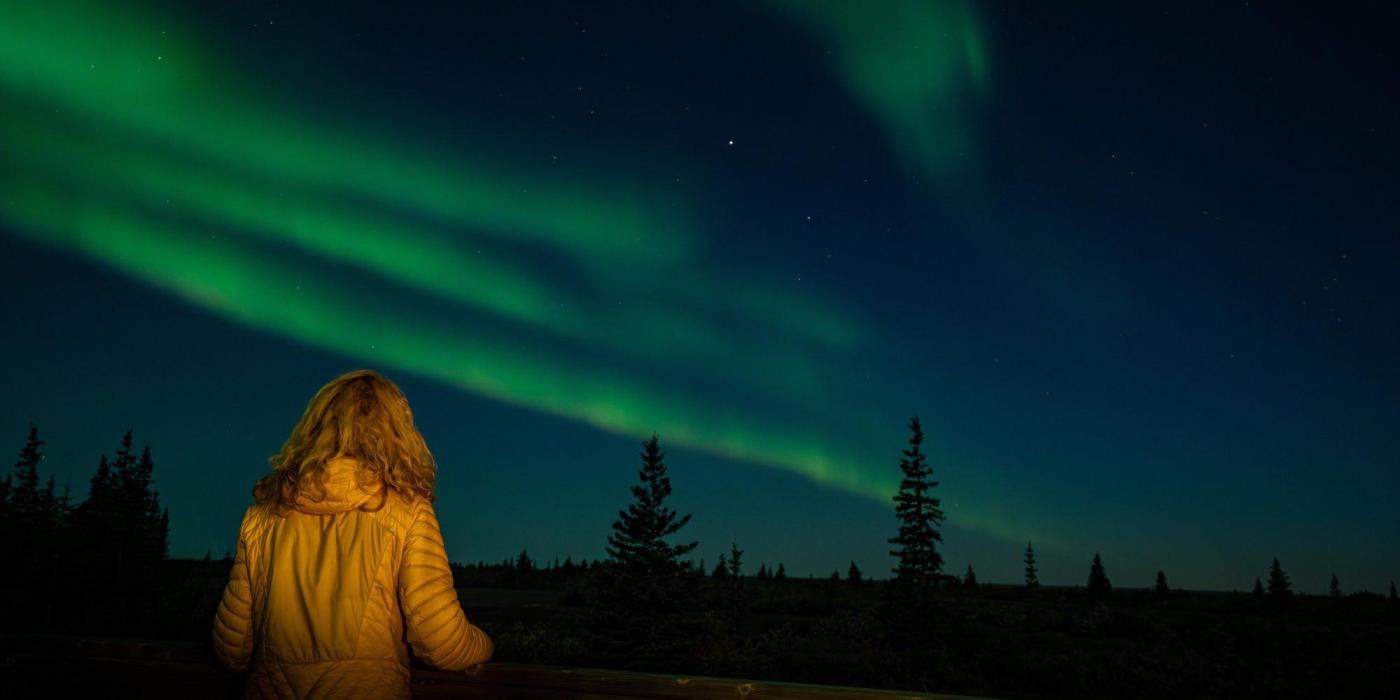
Credit: Wibke Helfrich

Key Things to Know about the Northern Lights in Manitoba

  • Churchill sits directly beneath the auroral oval and sees aurora activity on up to 300 nights a year.
  • Plan a Churchill trip between January and March for the best odds of seeing the northern lights when the nights are long and dark.
  • Spruce Woods Provincial Park, Manitoba’s first designated Dark Sky Preserve, and Birds Hill Provincial Park and Oak Hammock Marsh near Winnipeg are all central Manitoba options when the KP index climbs.
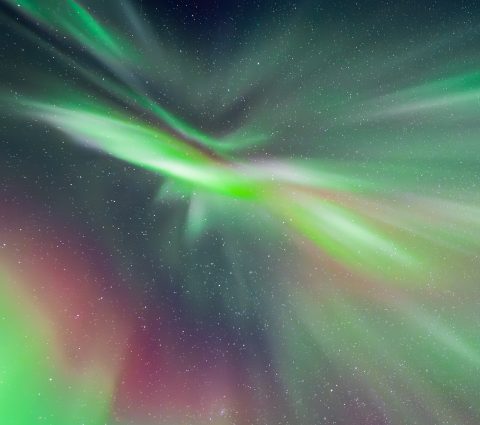
  • The aurora’s colours come from solar particles striking gases at different heights: oxygen produces green and red, and nitrogen produces blue, purple and pink.
  • Check the forecast, dress accordingly and plan for more than one night outside, because the aurora keeps its own schedule.

The Stories Behind the Lights

What Do Indigenous Stories Tell Us About the Northern Lights?

Long before telescopes and satellites, the night sky held meaning far beyond its beauty. Indigenous teachings and traditional knowledge view the aurora borealis as a living, dynamic connection to ancestors, spirits and the Earth's ecosystem. Across Canada, First Nations, Inuit and Métis communities have their own way of reading the same sky that offer a window into their ways of life.

How Have Indigenous Peoples Understood the Northern Lights?

Listen to Elder and science facilitator Wilfred Buck share the stories he was told about the northern lights as a child in Opaskwayak Cree Nation.

Video Transcript

My name is Wilfred Buck, greetings my relatives. I'm from Opaskwayak Cree Nation.

As a child, I grew up in the northern boreal forest near the Saskatchewan/Manitoba border on the Saskatchewan River.

In the winter evenings when it got dark sometimes we would get an amazing display in the sky, and these were, of course, the northern lights. We were told as children that we shouldn't whistle at the northern lights in the night time. If we did they told us that the northern lights would come to get us and take us away. In the Cree language, the northern lights are called "Wāwātēwak".

When there are one ore two strands in the sky moving and when they totally fill the sky, they're dancing around, sometimes you could hear the static, you could smell the ozone even.

We call them "cîpayak nîmihitowak" which means the spirits are dancing.

Of course we tried to do it, we tried to whistle at the northern lights all the time. But, I guess the reason we were told this, is during the long winter months, of course, it was dark for hours and hours upon end in the winter and there was very little daylight.

And so one of the things our parents and elders didn't want us to do was to go out in the bush and run around in the busy, especially at night. Because in the night, there was a lot of animals, hungry animals, because it was winter and there was very little food.

And they were afraid that we would get taken away by a wolf or something. And so, that was one of the scares they put into us to keep us near the village and near the community so we wouldn't go wandering around the bush.

So that's "cîpayak nîmihitowak", that means the spirits are dancing.

That's the story of the northern lights.

Miigwetch.

Video used with permission.

For the Nehethowuk (Cree), the dancing northern lights carry the spirits of ancestors—a shimmering bridge between the living and those who've passed on. Some traditions carried warnings, too: whistle at the lights, and some believed they'd sweep down and take you away; clap instead, and they'd retreat.

The Inuit tell a different story: to them, the shimmering northern lights are spirits playing a game in the sky, using a walrus skull as their ball. On Nunivak Island in the Bering Sea, the story flips—it's walrus spirits playing with a human skull instead. Further north, for Inuit living near Hudson Bay, the lights were something to be wary of rather than welcomed, seen as the lanterns of demons chasing lost souls through the dark.

It's a small reminder that for many Indigenous Peoples across Canada's North, the aurora is alive with meaning, caution and story.

The Science Behind the Lights

What Causes the Northern Lights?

Another way of understanding the northern lights is the scientific explanation, which typically starts with the sun. The natural light shows we call the aurora borealis are caused by magnetic storms triggered by solar activity on the surface of the sun. Typically, this activity is either solar flares or coronal mass ejections (CME) which are ejected gas bubbles. It’s why you might see something called a CME rating on aurora forecast watch sites, used to indicate whether there’s a high or low chance of seeing the aurora.

How Do the Northern Lights Form?

When the solar particles reach Earth, they’re deflected by the magnetic field towards either the North or South magnetic poles, where they then collide with gases in the upper atmosphere. Those collisions release energy as light, which is what we see as the aurora borealis in the North and aurora australialis in the South.

Why Are the Northern Lights Different Colours?

The colours of the northern lights change depending on which atmospheric gas is struck by the solar particles and how high up the collision happens:

  • Green, the most common colour, comes from oxygen at roughly 100–150 km above Earth's surface.
  • Red comes from oxygen higher up, generally above 200 km.
  • Blue, purple and pink come from nitrogen, typically below 100 km, and tend to appear along the lower edge of a display during more active solar conditions.

What’s the Auroral Oval?

You may have heard the term “auroral oval” before, especially in relation to the location of northern lights viewing destinations around the world. The auroral oval is a ring-shaped area above the north or south polar regions that changes size depending on the amount of solar activity. The higher the solar activity, the further outward the ring expands, pushing the northern lights toward lower latitudes from the north or higher ones from the south.

In the North, Canada, Alaska, Greenland, Iceland and other Nordic countries, are located beneath the auroral oval which means you have a higher chance of seeing the northern lights in these destinations. In fact, Churchill, Manitoba records nearly 300 nights a year of aurora activity thanks to its location directly beneath the auroral oval.

Where Can I See The Northern Lights in Manitoba?

There are several places to stop and view the night sky when the northern lights are out:

  • Birds Hill Provincial Park is a popular, easy-to-reach option just outside Winnipeg, with very little light pollution to get in your way. It's a great spot to watch the sky when the KP index climbs!
  • Spruce Woods Provincial Park is Manitoba's first officially designated Dark Sky Preserve—and one of the best places in the province to watch the lights dance on an active night.
  • Whiteshell and Nopiming Provincial Parks are also considered dark-sky recreational areas, perfect for a quiet night of stargazing and aurora watching when conditions line up.
  • Riding Mountain National Park is another great spot to catch the northern lights, especially if you head to a spot with a clear view of the sky facing north.
  • Thompson, Flin Flon and The Pas are treated to the aurora borealis more often than most, thanks to their northern location far from the light pollution of southern Manitoba.
  • Churchill remains Manitoba's (and Canada’s!) best-known and most reliable aurora destination, with the sky putting on a show up to 300 nights a year. For the best odds of seeing the lights, plan your trip between January and March.

Plan your Northern Lights Adventure

People have looked up at these lights for thousands of years, reading spirits and ancestors into their glow, or, later, tracing them back to solar particles colliding 150 kilometres overhead. Both understandings hold their own kind of truth and that layered history is part of what makes watching the aurora so powerful today.

Manitoba sits directly beneath the auroral oval, with dark-sky parks, small northern communities and Churchill's near300 clear nights giving you real odds of catching a display. Check the forecast, dress accordingly and plan for more than one night outside if you can—the aurora keeps its own schedule. But when it finally dances overhead, you'll understand why people have never stopped looking up.

You May Also Enjoy

The Northern Lights are Calling: Churchill or Yellowknife?

Churchill offers some of the most reliable northern lights viewing on the planet, logging 300+ nights of auroral activity per year.

Where, When and How to See Northern Lights in Churchill, Manitoba

Few experiences stir the heart quite like watching the northern lights dance across the subarctic sky. As ribbons of green and violet shimmer overhead, time seems to pause. Many visitors describe it as humbling and awe-inspiring — a moment where you feel...
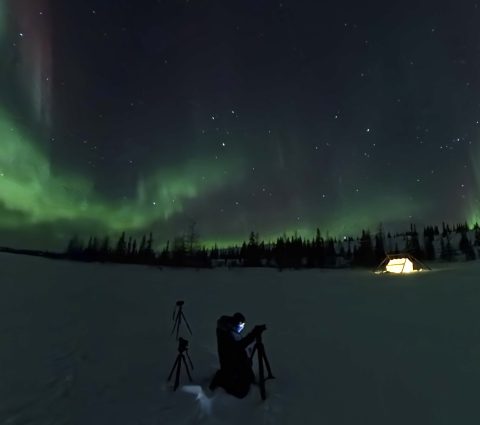
Chasing the Northern Lights in Manitoba: What I've Learned Behind the Camera

After photographing and filming the northern lights (aurora borealis) more than 100 times, I've realized something: the best aurora borealis photos have very little to do with having the most expensive camera. More often than not, they're captured by the...
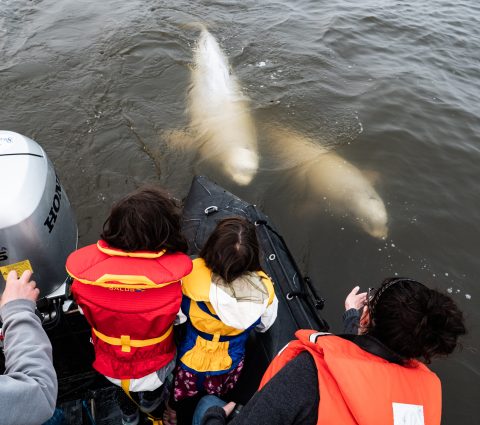
A Churchill Calendar: When to See What

Churchill, an isolated town in Manitoba’s north along the Hudson Bay coastline, is a magnet for outdoor adventurers and nature lovers. Experiencing Churchill’s natural wonder trilogy – kayaking with belugas, chasing the northern lights and seeing polar...

About The Author

Allison Dalke works with Travel Manitoba to inspire travellers to discover the people, places and experiences that make Manitoba unique. Renée Simcoe works with Indigenous Tourism Manitoba to support and promote Indigenous-owned and -led tourism businesses across Manitoba.

Travel Manitoba and Indigenous Tourism Manitoba